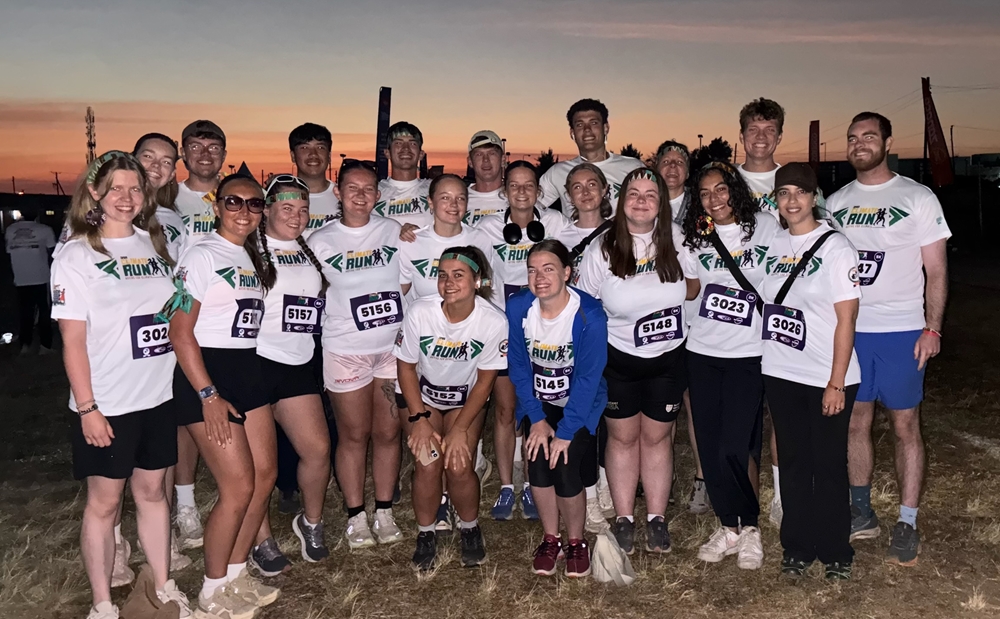
The Zambia team from Loughborough. Sarolta’s the little one in the back row!
I had the privilege of being part of a multi-university sport development project earlier this year, which culminated in me spending August in Lusaka, the capital of Zambia, with 20 students and a handful of other staff members.
The project is called Volunteer Zambia, where eight UK universities work together with the Zambian organisation, Sport in Action, to support and build sustainable sporting provision for deprived areas of the country. In practice, students with sports coaching experience are recruited, go through a series of training, preparation, and fundraising programmes, and then spend eight weeks volunteering in Lusaka. During their time there, they are allocated one or two specific ‘hubsites’ and a few young local coaches each, with whom they work and upskill. A ‘hubsite’ is a community sports field (or maybe a local school’s sports ground) where the children from the local area can walk to and play.
The benefits of this arrangement are both huge and humbling:
Children – regardless of their age, background, whether they have a home or not, whether they go to school or not – have somewhere to go where they are safe, have fun and learn to play a sport. With that, also comes social and life skills. For free.
Those children who are talented in a sport have a space to improve their skills further.
Teenagers could become peer leaders in their sport, be guided and supported in picking up leadership and sports coaching skills.
And all of this is run six days a week, on a voluntary basis, by dedicated locals and a handful of admirable coordinators. Humbling.
While I could write reams and reams about the incredible impact this project has on young people’s lives, the nine months of fundraising our Loughborough University team of six (four students and two staff) undertook to raise £15,000; the extraordinary skill and maturity the students demonstrated during their eight week project; or even the shocking poverty I witnessed that left me somewhat traumatised; I decided instead to take a lighter approach and share some of the more unexpected things I discovered during my stay in Lusaka.
European restaurants and bars that wouldn’t look out of place in the centre of Nottingham! On weekends, we treated ourselves to eating out, as the prices were surprisingly low, even by students’ standards. A favourite spot was Eataly, a clever play on words, and a fantastic Italian restaurant with beautiful food. Another evening, we visited a sports bar called Copenhagen Yard – a stylish mix of Scandinavian design and industrial chic, complete with a beer garden and several screens showing the latest premier league game. The only thing that reminded us we weren’t actually in northern Europe was the live DJ playing fantastic, distinctively African music.
An impossibly difficult language! As a Hungarian, I am used to my native language being one of the hardest for people to learn, and to learning new languages myself fairly easily. Or so I thought. While English is the official language of Zambia, there are over 70 spoken languages. In Lusaka alone, two or three are most common. Trying to learn even a little of them? A massive challenge!
Beer being the healthy option? Let me explain. There is no sugar tax in Zambia – with poverty being a far greater concern than obesity – so popular soft drinks contain nearly twice as much sugar as those in the UK. With the best intentions, I tried to choose soft drinks when eating out (being the ‘grown up’ amongst students), but the price of a small bottle of fizzy pop was the same as a small bottle of local lager. Well… I knew which one I’d rather have.
There are climate campaigners there too! This really surprised me, especially after seeing that there is no visible system for refuse collection or recycling. What is impossible to miss are the piles of plastic rubbish everywhere, often burning by the roadside adding smog to the already dusty air whilst supermarkets continue selling everything wrapped in plastic, just like back here.
So, after all that, I didn’t expect to find myself taking part in a climate run in Lusaka! Because daytime traffic is horrendous, the run started at 7 am on a Saturday, on a loop along a main road with the traffic still flowing beside us. By the time the sun came up, we were finished. On the bright side, the sunrises in Zambia are spectacular.
And finally, the biggest surprise of all! We were invited to volunteer as Games Masters at the Highland Games, organised by the Lusaka Caledonian Society. Yes, you read that right. I have lived in the UK since 2002 and have never actually been to this Scottish tradition here. Yet somehow, I found myself in Zambia, a Hungarian, middle-aged woman, explaining the rules of stone throwing to competing teams! It was, without doubt, the most unexpected experience of the trip! And an incredibly fun day for everyone involved!
For reference: to find out more about the project, see www.volunteer-zambia.com/ or follow Volunteer Zambia on Social Media.
Sarolta Batki
Barrow Voice is published by Barrow upon Soar Community Association.(BUSCA)
Opinions expressed are not necessarily endorsed by the editorial committee or the Community Association.
Barrow Community Association is a registered Charity No: 1156170.
Advertising Deadline
For Advertising Deadline go to current issue
Copy to: The Editor
62 Sileby Road, Barrow on Soar, LE12 8LR
editor@barrowvoice.co.uk